Quick answer: At a major station you will find a locker, but not always the size you need. The large ones go first and stay gone until evening. Check the size against your case before you build a plan around one. If everything is full, staffed luggage-storage counters and same-day delivery to your hotel both exist, and both cost more than a locker.
Get the Bounce luggage-storage coupon on Klook →
Solve Your Luggage Problems in 7 Minutes
Have you ever dragged a 23kg suitcase through Shibuya's bustling Scramble Crossing? That exhausting "luggage nomad" experience ends today.
After reading this guide, you'll know exactly which locker fits your bags, how much it costs, and whether you can use cashless payment, all at a glance with the charts below. This knowledge will save you up to ¥2,000 in unnecessary fees and free up precious hours of your sightseeing time.

I've personally cross-referenced official station websites, on-site signage, and railway company releases to compile only first-hand information current as of May 2025. Bookmark this page for a hands-free, stress-free Japanese adventure!
What Makes Coin Lockers Japan's "Travel Superpower"
- Coin lockers in Japan are incredibly abundant. Tokyo Station alone houses over 1,500 lockers across more than 100 locations throughout its above and below-ground areas.
- The average tourist walks approximately 8km daily in Japan, and whether or not you're carrying luggage significantly impacts your energy levels. When I first visited Japan without using lockers, I was exhausted by midday, a mistake I never repeated.
- Most JR stations have locker search kiosks inside the ticket gates, allowing you to instantly locate available lockers by size and location.
How to Use Different Locker Types (2 Main Systems + Extras)
| Type | Main Payment Methods | Features | Where to Find |
|---|---|---|---|
| Key Type (Cash Only) | ¥100/¥500 coins | Classic style with physical key. Common in rural stations. | Takayama, Kumamoto, and other regional stations |
| Touch Panel (Standard) | Cash/Transit IC cards | Operated via screen → unlock with IC card. PIN issued only for cash transactions. | Almost all stations in Tokyo, Kyoto, Osaka |
| Touch Panel (Multi-Payment Terminal) | Transit IC cards/Electronic money (WAON etc.)/Credit card touch (Visa, Mastercard, JCB, Amex, Diners, Discover)/Major QR payments | "Upgraded version" of standard machines with added payment terminal. Most payment options available. | 8 Tokyu line stations (including Shibuya, Jiyugaoka) and expanding |
Touch panel lockers all follow the same operation flow regardless of generation. Just remember that "multi-payment" versions are simply upgraded models with more payment options.
Why Size, Price and Dimensions Matter: Quick Reference Chart
| Size | Internal Dimensions (mm)* | Fee/Day | Availability | Transit IC Cards | Credit Card/QR |
|---|---|---|---|---|---|
| S | H 200-400 × W 340 × D 570 | ¥300-400 | ★★★ | ◎ | ○ |
| M | H 550 × W 340 × D 570 | ¥500-600 | ★★☆ | ◎ | ○ |
| L | H 840 × W 340 × D 570 | ¥700-800 | ★★☆ | ◎ | ○ |
| XL | H 1030 × W 340 × D 570 | ¥800-1,000 | ★☆☆ | ○ | ○ |
*Based on JR East "Coin Locker Dimensions Guide"
Bag too big for a locker? XL lockers are the hardest to find (★☆☆ in the chart above), and a 28-inch case often will not fit even in one. Same-day luggage delivery between Tokyo hotels and the airport costs more than a locker, but it removes the search entirely and you move hands-free all day. Compare Tokyo luggage delivery on Klook →
Payment Methods and Potential Pitfalls
Using Transit IC Cards (Suica/PASMO/ICOCA etc.)
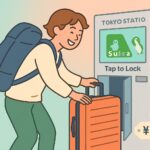
- Place your luggage inside and close the door
- Select "IC Card" on the screen
- Touch your card → Locker locks immediately
- To retrieve, touch the same card to unlock
About PINs with IC cards: You cannot lock using PIN alone with IC cards. However, some models will print a receipt with a "rescue PIN" in case you lose your card.
Using Cash (Coins)
- After completing the transaction, a receipt with a 4-digit PIN is printed. Use this number to unlock when retrieving your luggage.
- Note that crossing midnight will automatically add another day's charge under the calendar day system.
Using Credit Cards & QR Codes (Multi-Payment Terminals)
- Touch-payment compatible cards (Visa/Mastercard/JCB/Amex/Diners/Discover) all work.
- The card used for payment serves as your "key". Touch it again to unlock.
- PIN-only unlocking is generally not available. While some models provide receipt+PIN for emergency access, the basic expectation is that you'll present the same card/QR code to retrieve your items.
Calendar Day System and the "3-Day Rule"
- Calendar Day System: Fees reset at midnight (00:00). If you store at 23:59, you'll be charged for an additional day just one minute later.
- 3-Day Rule: Most stations limit storage to a maximum of 3 days. Exceeding this results in your luggage being transferred to the station office plus additional handling fees.
Staying longer than 3 days? Station lockers cannot cover you. As noted above, most stations clear bags once the limit passes. Staffed storage counters accept luggage for longer periods instead, and you can reserve a spot before you arrive rather than hunting for a free locker. Get the Bounce luggage-storage coupon on Klook →
Screenshot This Guide for a Hands-Free Journey
With this guide, you've mastered the potential pitfalls of coin lockers: types, sizes, payments, and time limits. Now you can head straight to the optimal locker upon arrival, freeing your hands to explore Japan more freely and comfortably.

During my last trip, I used this knowledge to store my backpack at Kyoto Station before wandering through Arashiyama's bamboo forest unencumbered. It was a completely different experience from my first visit.